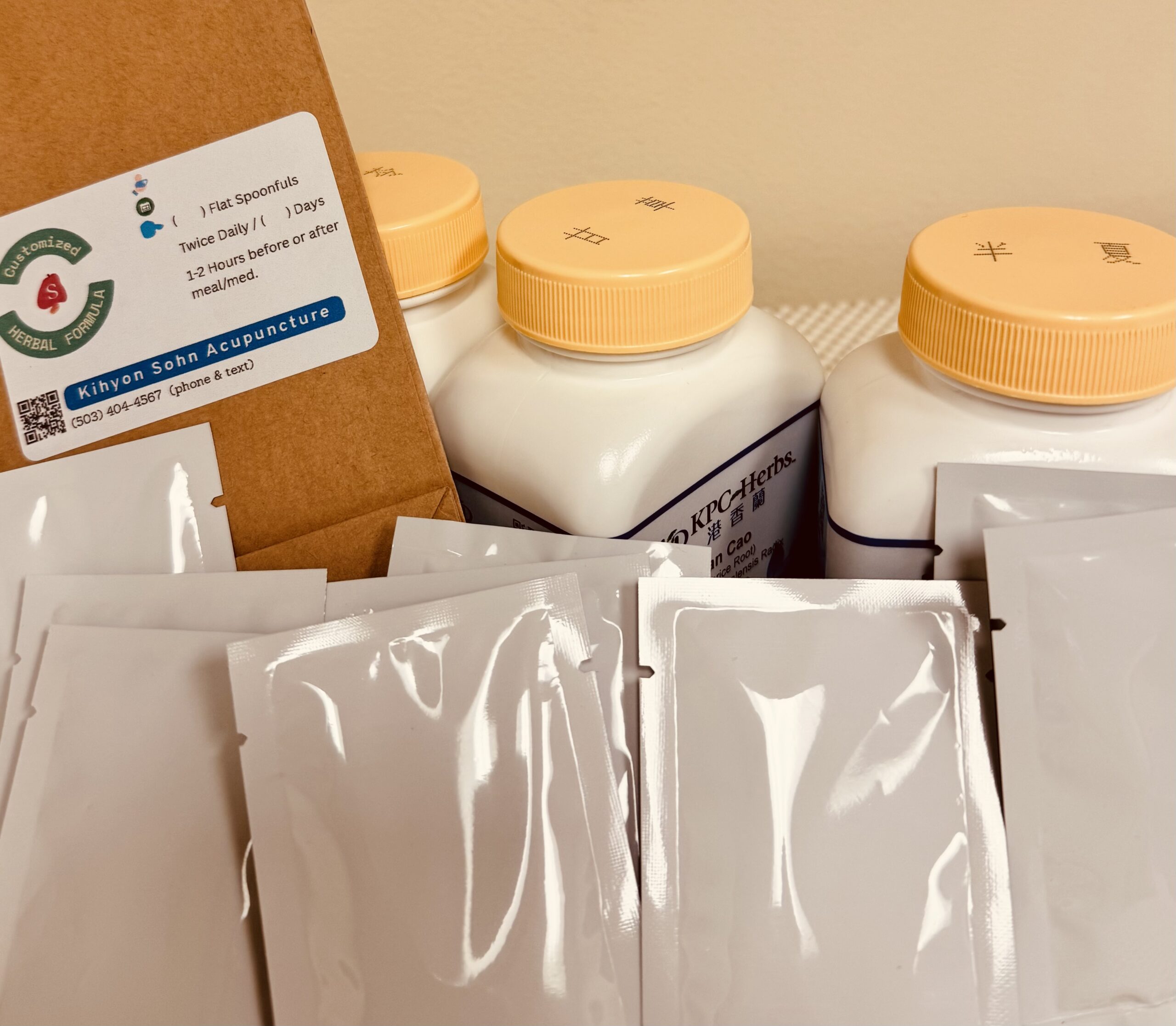
What Makes Traditional Herbal Medicine Different From Taking a Supplement
Most patients who ask about herbal medicine have already tried something from a supplement aisle — a probiotic, a magnesium blend, a tea marketed for “gut health” or “calm.” Some of it helps a little. Most of it doesn’t do much at all. That’s usually not because herbal medicine doesn’t work — it’s because a bottle made for everyone wasn’t made for you.
Traditional herbal medicine, the kind used in Korean and East Asian medical practice for centuries, works on a different premise entirely: your formula is built around your specific pattern, not your diagnosis label. Two patients with the same complaint can walk out with two completely different prescriptions.
Individualized, Not Off-the-Shelf
When we prescribe herbal medicine at our Beaverton clinic, we’re not reaching for a pre-made formula off a shelf. We’re building a combination of herbs based on your pulse, your tongue, your symptom pattern, your sleep, your stress levels, and how your body is currently functioning as a whole system.
That’s the core difference between a supplement and a prescribed herbal formula. A supplement is designed to address one thing, for everyone, the same way. A traditional formula is designed to address your underlying pattern — which is why it’s prescribed by a trained practitioner rather than picked up at a store.
“The goal isn’t just to treat the symptom in front of us. It’s to correct the underlying imbalance producing it — so the formula changes as your body changes.”
How Herbal Medicine Pairs With Acupuncture
Acupuncture and herbal medicine come from the same medical tradition, and they tend to work best together rather than as separate, competing options. Acupuncture regulates the nervous system and stimulates the body’s own regulatory mechanisms in the moment. Herbal medicine continues working between sessions, supporting digestion, sleep, hormonal balance, or nervous system regulation around the clock.
Patients who add herbal medicine to their acupuncture treatment plan often notice progress happens faster, and holds more consistently between visits, than acupuncture alone — particularly for chronic patterns like IBS, insomnia, anxiety, and long-standing pain.
What Herbal Medicine Is Used For
- Digestive disorders — IBS, bloating, chronic constipation, and functional digestive complaints where testing has come back normal
- Sleep and nervous system regulation — insomnia, racing thoughts at bedtime, and stress-driven sleep disruption
- Mood and stress patterns — anxiety and low mood connected to nervous system and digestive dysregulation
- Pain and musculoskeletal conditions — supporting recovery and reducing inflammation alongside acupuncture treatment
Working With a Trained Herbalist Matters
Herbal medicine is a real medical intervention, not a neutral wellness product — which is exactly why it should be guided by someone trained to prescribe it. Herbs can interact with medications, and the right formula for one person’s pattern may be the wrong one for someone else’s, even with identical symptoms. As a certified herbalist, part of the evaluation is reviewing your current medications and health history so your formula is appropriate for your specific situation, not just your complaint.
This is also why formulas are adjusted over time. As your pattern shifts — as digestion improves, or sleep stabilizes, or pain resolves — the formula is refined rather than kept static, the way a one-size prescription would be.
What to Expect
If herbal medicine is recommended as part of your treatment plan, you’ll typically take it daily, alongside your acupuncture visits, in the form most practical for your routine — usually granules. We’ll check in on how you’re responding and adjust the formula as your pattern changes. Most patients notice initial shifts within a few weeks, with fuller results building over one to three months depending on the condition.
Ask About Adding Herbal Medicine to Your Care
If you’re already receiving acupuncture with us and want to accelerate your progress — or if you’ve been managing a chronic digestive, sleep, or stress-related pattern and haven’t tried an individualized herbal approach — it’s worth asking whether herbal medicine is a good fit for your treatment plan. It’s not an add-on for everyone, but for the right pattern, it often makes the biggest difference.
Ask About Herbal Medicine at Your Next Visit
Serving Beaverton, SW Portland, Tigard, Lake Oswego, Aloha, Hillsboro, and Cedar Hills with individualized Korean-style acupuncture and traditional herbal medicine.